

Getting people to visit your website is only the beginning.
You can have thousands of website visitors, hundreds of social media followers, and a strong presence on Google, but if those people never become leads or customers, your marketing is not doing its full job.
This is where Full-Funnel Digital Marketing comes into play.
A full-funnel approach looks at the entire customer journey—from the moment someone discovers your brand to the point where they make a purchase and eventually become a loyal customer. Instead of focusing on just one channel or one stage of the buying journey, it connects awareness, consideration, conversion, and retention into one complete system.
For businesses competing in an increasingly crowded online marketplace, understanding the digital marketing funnel can make the difference between simply generating traffic and generating measurable business growth.
What Is Full-Funnel Digital Marketing?
Full-Funnel Digital Marketing is a marketing approach that targets potential customers at every stage of their journey.
Think about your own buying behavior. You may first discover a brand through a Google search or social media post. You might then visit its website, read reviews, compare alternatives, watch a video, and subscribe to an email list. Days or even weeks later, you may finally decide to purchase.
A full-funnel strategy is designed to support you throughout that entire process.
Rather than asking, “How can we get more clicks?” marketers ask a broader question:
“How can we move the right people from awareness to action and eventually turn them into repeat customers?”
That shift in thinking is at the heart of modern digital marketing.
Understanding the Digital Marketing Funnel
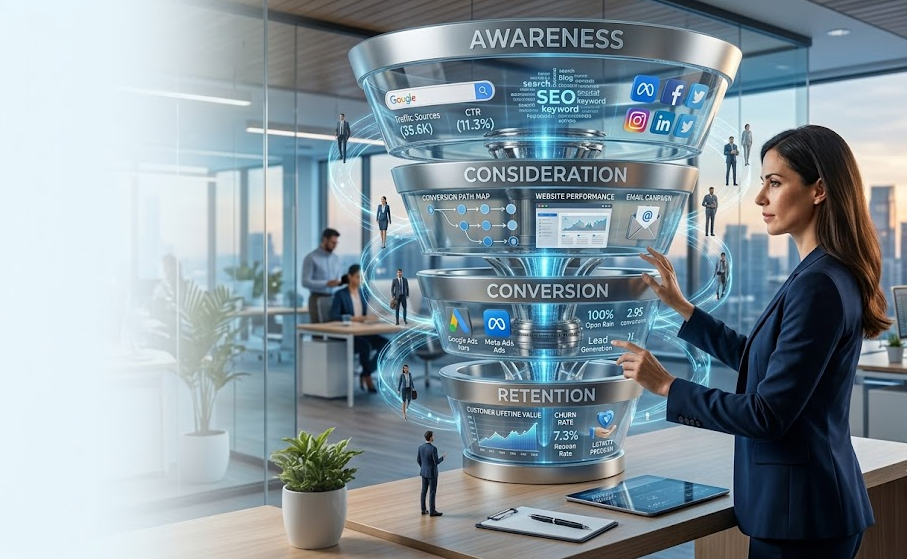
The digital marketing funnel represents the different stages a potential customer typically moves through before and after making a purchase.
While different businesses may define the stages differently, the funnel is commonly divided into four major areas:
1. Awareness: Getting Your Brand Discovered
At the top of the funnel, your audience may not know your business exists.
They may be searching for information, researching a problem, watching videos, scrolling through social media, or simply discovering new brands.
The goal at this stage is not necessarily to make an immediate sale. It is to attract the attention of people who could eventually become customers.
Content such as blog posts, educational videos, social media content, search engine optimization, digital PR, and awareness-focused advertising can help introduce your brand to the right audience.

For example, a company selling SEO services might create an article about “How to Improve Your Website’s Google Rankings” rather than immediately promoting its services.
The reader may not be ready to hire an agency yet—but the first relationship has been established.
2. Consideration: Helping People Evaluate Their Options
Once people know about your brand, they may begin looking for a solution to their problem.
This is the middle of the funnel.
At this point, your audience is asking questions such as:
- Is this solution right for me?
- Which company should I choose?
- How much does it cost?
- Can I trust this business?
- What makes this option different?
Your content needs to answer those questions.
Case studies, comparison articles, webinars, detailed guides, product demonstrations, testimonials, email campaigns, and educational content can all help potential customers move closer to a decision.
This stage is especially important because people rarely make purchasing decisions based on one interaction with a brand.
3. Conversion: Turning Interest Into Action
At the bottom of the funnel, your potential customer is much closer to taking action.
They may be ready to purchase a product, request a quote, schedule a consultation, sign up for a service, or contact your sales team.
Your job is to remove unnecessary friction.
A strong conversion experience might include a clear call-to-action, simple forms, transparent pricing, compelling product information, trust signals, reviews, guarantees, and an easy checkout process.
Even small improvements can have a significant impact.
For example, if 10,000 people visit a landing page but only 100 complete the desired action, improving the conversion rate can create meaningful growth without requiring the business to generate additional traffic.
4. Retention: What Happens After the Conversion?
A common mistake in digital marketing is treating the purchase as the finish line.
It isn’t.
Once someone becomes a customer, businesses have an opportunity to build a long-term relationship.
Email marketing, customer support, loyalty programs, personalized recommendations, educational content, remarketing, and post-purchase communication can help keep customers engaged.
A satisfied customer may purchase again, recommend your brand to others, or become a valuable source of referrals.
That is why modern funnel strategies often extend beyond conversion and include retention and advocacy.
Why a Full-Funnel Approach Matters
Many businesses operate individual marketing channels without connecting them.
One team works on SEO. Another manages social media. Someone else runs paid advertising. Meanwhile, email marketing operates separately.
Each channel may produce results, but the overall customer journey can become disconnected.
A Full-Funnel Digital Marketing approach brings these activities together.
For example, someone might discover your brand through an organic Google search. After reading your article, they subscribe to your newsletter. Later, they see a retargeting advertisement. They return to your website, read a case study, and eventually request a consultation.
Every interaction contributes to the same customer journey.
This makes marketing more strategic rather than simply channel-focused.
How to Create an Effective Digital Marketing Strategy
A successful digital marketing strategy begins with understanding your audience.
Before choosing platforms, creating content, or launching campaigns, identify who you want to reach and what they actually need.
Start With Customer Intent
Different people have different levels of buying intent.
Someone searching “what is SEO” is probably looking for education.
Someone searching “best SEO agency for small business” may be comparing providers.
Someone searching for a specific agency and pricing information may already be close to making a decision.
Your marketing strategy should reflect these differences.
Create content that matches the intent behind each search rather than trying to sell the same message to everyone.
Build Content for Every Funnel Stage
One of the strongest ways to implement full-funnel marketing is to create different content for different stages.
At the awareness stage, focus on educational and problem-solving content.
During consideration, provide deeper information that demonstrates expertise and builds trust.
At the conversion stage, focus on proof, benefits, objections, and clear calls-to-action.
After conversion, create content that helps customers get more value from their purchase and encourages them to stay connected with your brand.
The result is a content ecosystem rather than a collection of unrelated blog posts.
Connect SEO, Paid Advertising, Social Media and Email
A strong funnel does not depend on one marketing channel.
SEO can attract people who are actively searching for information. Paid advertising can provide immediate visibility and support remarketing. Social media can build awareness and engagement. Email marketing can nurture leads and maintain customer relationships.
The key is making these channels work together.
For example, an SEO article can attract organic traffic. A relevant lead magnet can turn some visitors into subscribers. Email campaigns can nurture those subscribers. Paid remarketing can bring interested visitors back to the website. A strong landing page can then turn that interest into a conversion.
This is the practical power of a connected digital marketing funnel.
Measure the Entire Funnel, Not Just Traffic
Traffic is an important metric, but it should not be the only metric you track.
A business can receive a huge amount of traffic and still struggle to generate revenue.
Instead, measure performance across the customer journey.
Awareness metrics may include impressions, reach, organic visibility, and website traffic.
Consideration metrics can include engagement, time on page, returning visitors, content downloads, and email sign-ups.
Conversion metrics may include leads, sales, conversion rate, cost per acquisition, and revenue.
For retention, businesses can monitor repeat purchases, customer lifetime value, retention rate, referrals, and engagement.
Looking at these metrics together gives you a much clearer picture of whether your marketing is actually working.
Common Full-Funnel Marketing Mistakes
One of the biggest mistakes is trying to sell too early.
Not every visitor is ready to buy. Someone who has just discovered your brand may need education before they are comfortable making a purchasing decision.
Another mistake is creating content without considering intent.
Publishing dozens of articles does not automatically create a successful funnel. Every piece of content should have a purpose and connect to a broader customer journey.
Businesses also frequently overlook the post-purchase experience. If marketing stops immediately after the sale, valuable opportunities for repeat business and referrals can be lost.
Finally, avoid measuring every campaign using the same metric. A top-of-funnel awareness campaign should not necessarily be judged in exactly the same way as a bottom-of-funnel sales campaign.
The Future of Full-Funnel Digital Marketing
Digital marketing is becoming increasingly interconnected.
Customers move between search engines, social media, websites, email, video platforms, review websites, and other digital touchpoints before making decisions.
That means businesses need to think beyond individual campaigns.
The strongest brands are building connected experiences where every interaction has a purpose.
Artificial intelligence, automation, personalization, first-party data, improved analytics, and better customer journey tracking are also making it possible to deliver more relevant experiences at scale.
However, technology alone does not create a successful funnel.
The foundation remains the same: understand your audience, provide useful information, build trust, remove friction, and create a consistent experience from the first interaction to long-term customer relationships.
Final Thoughts
Full-Funnel Digital Marketing is not about being everywhere or spending more money on advertising.
It is about understanding the complete customer journey and making every stage work together.
A well-designed digital marketing funnel attracts the right audience, educates potential customers, builds trust, encourages action, and continues the relationship after conversion.
When combined with a thoughtful digital marketing strategy, this approach can help businesses move beyond chasing clicks and start building a marketing system focused on meaningful business results.
The goal is simple: turn attention into engagement, engagement into customers, and customers into long-term advocates.
Frequently Asked Questions
What is Full-Funnel Digital Marketing?
Full-Funnel Digital Marketing is an approach that addresses every stage of the customer journey, including awareness, consideration, conversion, retention, and advocacy.
What are the main stages of a digital marketing funnel?
The main stages generally include awareness, consideration, conversion, and retention. Some businesses further divide these stages into TOFU, MOFU, and BOFU.
Why is a digital marketing funnel important?
A digital marketing funnel helps businesses understand where potential customers are in their buying journey and deliver the right content, message, and experience at each stage.
How does SEO fit into a full-funnel strategy?
SEO can support multiple stages of the funnel. Informational content can attract people during the awareness stage, while commercial and transactional content can reach users who are closer to making a purchase.
What is the difference between a marketing funnel and a digital marketing strategy?
A marketing funnel describes the stages customers move through, while a digital marketing strategy explains how a business will use channels, content, campaigns, and resources to achieve its marketing goals across those stages.




Add comment